 Solution
 Technology
 Application


Ion exchange resin regeneration is an essential step to restore the exchange capacity once the resin becomes saturated. This process is necessary to recover performance, maintain water quality, and prolong the system’s lifespan. Please follow the detailed guide below from ATS Water Technology.
1. What is ion exchange resin regeneration?
Regeneration of ion exchange resin is the process of restoring the resin’s original active state after ion saturation. This is carried out by introducing a regenerant solution containing the same type of ions as the resin’s functional group (e.g., Na⁺ for sodium-form cation resin or Cl⁻ for chloride-form anion resin) into the ion exchange column. The regenerant displaces the adsorbed ions, thereby restoring the resin’s exchange capacity and ensuring stable operation.
1.1. Benefits of ion exchange resin regeneration
Not only does ion exchange resin regeneration help maintain output water quality, but it also reduces costs and extends system lifespan. When performed properly, regeneration brings several key benefits:
- Maintain water treatment performance: Keeps the resin working stably and ensures consistent water quality.
- Save operating costs: Regular regeneration extends resin lifespan, reducing replacement costs.
- Meet water quality standards: Especially important in food, pharmaceuticals, and ultrapure water production.
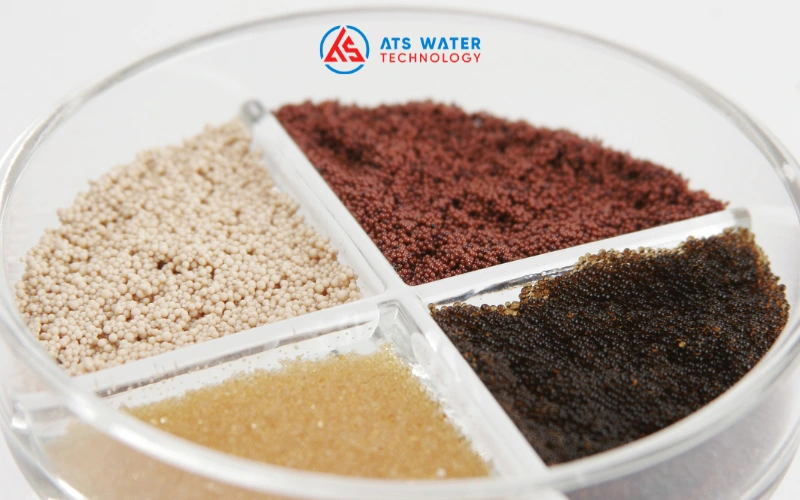
1.2. Chemicals used in ion exchange resin regeneration
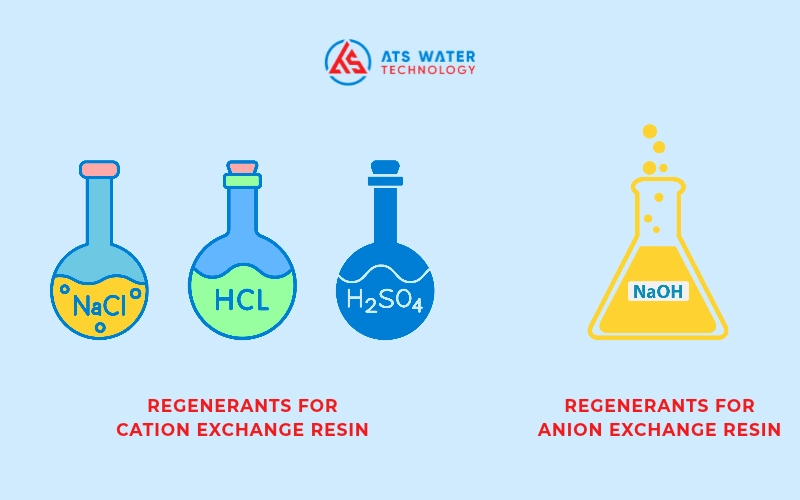
To regenerate cation and anion exchange resins effectively, selecting the right chemicals is critical. Depending on the resin type, different regenerants are used:
- Cation exchange resin:
- Na⁺ form: Sodium chloride solution (8–12%).
- H⁺ form: Strong acids such as HCl or H₂SO₄.
- Anion exchange resin:
- Cl⁻ form: Sodium hydroxide solution (2–6%).
- OH⁻ form: Sodium hydroxide or another suitable alkali.
Additionally, some processes may include supporting chemicals such as NaHSO₃ for deoxygenation or disinfectants to prevent microbial growth.
2. Ion exchange resin regeneration process
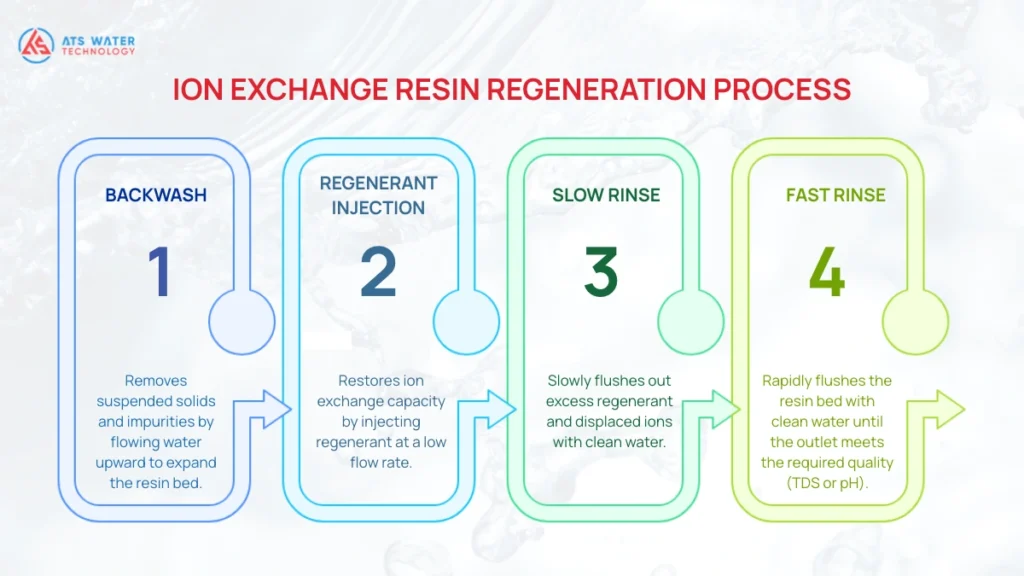
Regeneration is not simply rinsing and adding chemicals—it must be performed in the correct sequence to achieve optimal results. Below is the standard procedure recommended by ATS Water Technology:
- Backwash:
- Purpose: Remove suspended solids, impurities, and deposits from resin beads.
- How to perform: Water is pumped upward through the resin column, expanding and loosening the resin bed to flush out contaminants.
- Regenerant injection
- Purpose: Restore the resin’s original exchange capacity by replacing saturated ions.
- How to perform: The regenerant solution (e.g., NaCl solution for cation resin or NaOH solution for anion resin) is injected into the column at a low flow rate. This allows ions in the regenerant to have sufficient contact time to exchange with the saturated ions on the resin surface.
- Slow Rinse
- Purpose: To remove excess regenerant and the displaced ions from the column.
- How to perform: Clean water is allowed to flow slowly through the column, washing away any remaining chemicals and impurities.
- Fast Rinse
- Purpose: To thoroughly flush the column, ensuring no residual regenerant remains, while re-compacting the resin bed.
- How to perform: Water flows rapidly from top to bottom until the outlet water meets the required quality (typically measured by TDS or pH).
3. Key considerations in regeneration of ion exchange resin
Certain mistakes during the ion exchange resin regeneration process can reduce efficiency or damage the resin. To ensure safety and effectiveness, keep in mind:
- Control chemical concentration: Too low → incomplete regeneration; too high → resin damage.
- Use the correct regenerant: Using the wrong chemicals lowers efficiency or harms the resin.
- Workplace safety: Wear protective gear, gloves, and goggles when handling acids or alkalis.
- Rinse water quality: Use clean water to avoid recontaminating the resin.
- Monitor regeneration cycles: Do not wait until full saturation before regenerating, to prevent loss of performance.
4. Frequently asked questions about ion exchange resin regeneration
Why is ion exchange resin regeneration necessary?
During operation, resins become saturated with ions and lose their exchange capacity. Regeneration restores their original state, maintains water quality, and extends resin lifespan.
What are the signs that ion exchange resin needs regeneration?
Some indicators include increased water hardness after treatment, failure to meet water quality standards, and higher pressure drop across the filter column.
Which chemicals are commonly used for regenerating cation and anion resins?
For cation resins: common regenerants include NaCl solution, HCl, or H₂SO₄ depending on system requirements. For anion resins: NaOH solution is typically used to restore ion exchange capacity.
Does regeneration frequency affect resin lifespan?
Yes. Over-frequent regeneration or overdosing can damage the resin, while delayed regeneration reduces performance.
How to regenerate ion exchange resin effectively?
The standard process includes: Backwash → Regenerant Injection → Slow Rinse → Fast Rinse.
Thus, ion exchange resin regeneration is a mandatory process to maintain water treatment efficiency, lower operating costs, and extend equipment lifespan. Proper regeneration—performed safely and at the right intervals—ensures stable system operation and compliance with water quality standards. For further consultation, please contact ATS Water Technology Co., Ltd today.
ATS WATER TECHNOLOGY CO., LTD
- Head office: 54/18 Bui Quang La, An Hoi Tay Ward, HCMC, Vietnam
- Branch office: 77 DHT10B, Dong Hung Thuan Ward, HCMC, Vietnam
- Consultation and support: (028) 6258 5368 – (028) 6291 9568
- Email: info@atswatertechnology.com
- Social media: Facebook | LinkedIn | YouTube
- Quick contact: Zalo Official | Telegram | WhatsApp